
TLDR
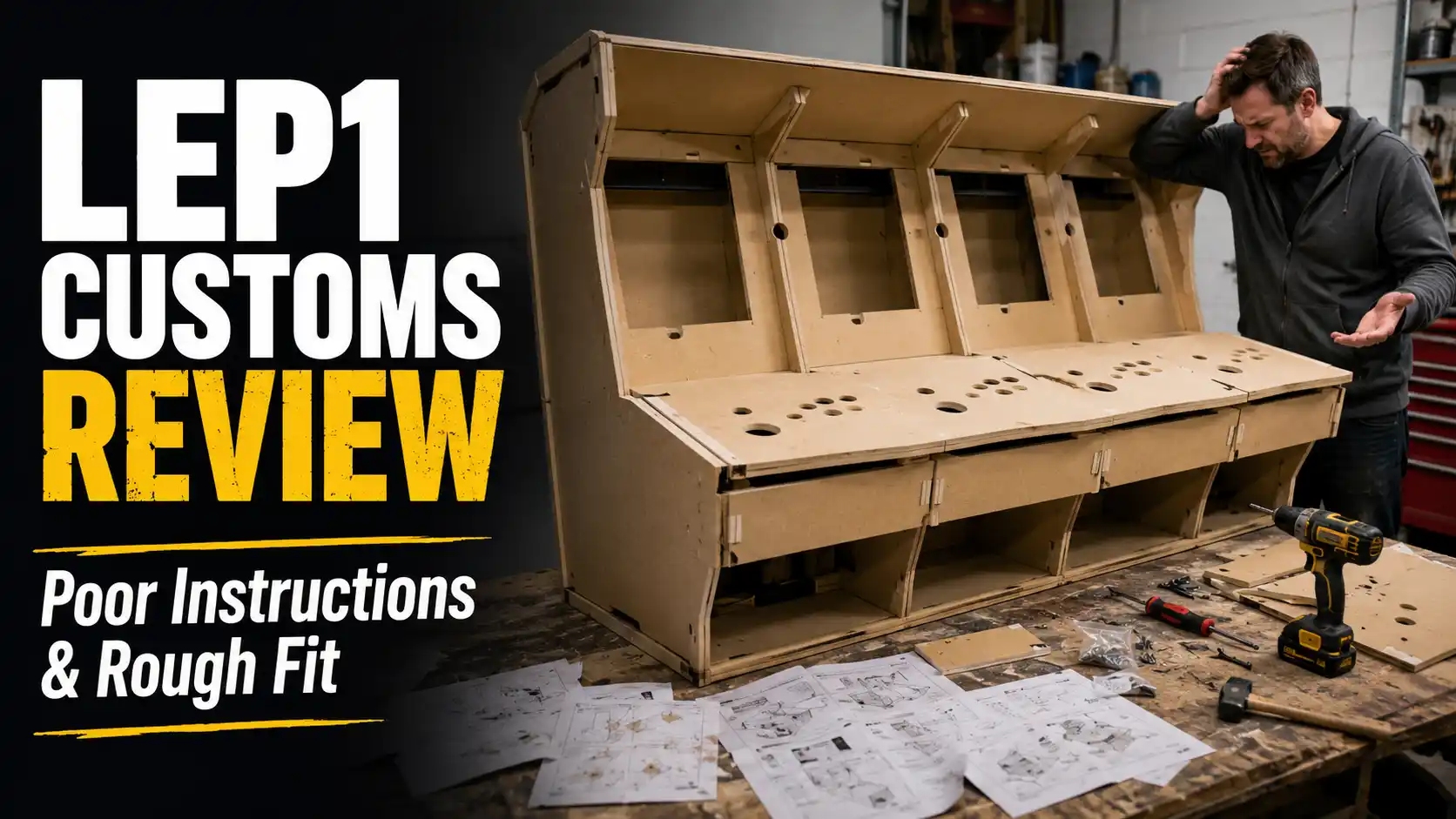
This LEP1 Customs review is based on my experience assembling the large 4-player standing cabinet.
The cabinet looked promising at first, but the build process was frustrating. The instructions were poor, the large cabinet was not explained clearly, the fit was rough and communication made the whole experience worse. Based on my experience, I would not recommend LEP1 Customs unless you are comfortable guessing, forcing parts together and improvising during assembly.
A Frustrating Cabinet Build From The Start
A large arcade cabinet kit should feel like a project. It should not feel like solving a puzzle with missing pieces.
This LEP1 Customs review comes from a disappointing experience with the large 4-player standing cabinet. On paper, the cabinet seemed like it had potential. A full-size arcade cabinet is exactly the kind of project that should be exciting once the parts show up. You expect some work, some patience and maybe a few moments where two people need to hold panels in place while everything gets tightened.
What I did not expect was how little useful guidance there would be.
The biggest issue was not just that the instructions were light. It was that they felt incomplete for the product I was actually building. For the large 4-player standing cabinet, the only real guidance I received was basically a small overview that appeared to be more focused on the tabletop version. That is not enough for a cabinet this size.
The Instructions Were Extremely Poor
The instructions were the main problem.
For a kit this large, clear instructions are not a nice bonus. They are part of the product. The cabinet has many pieces, and the builder needs to know what goes where, what order things should happen in and how to avoid making mistakes that become harder to fix later.
That was not my experience.
The instructions did not adequately explain how the full-size 4-player cabinet goes together. They did not give enough detail about part placement. They did not make the build feel confident or controlled. Instead, we had to keep looking at pieces, guessing how they might connect and trying to infer the assembly sequence.
That is frustrating on any project. It is especially frustrating on a large arcade cabinet where panels are bulky, alignment matters and mistakes can waste a lot of time.
A better instruction set should include:
- Clear step-by-step assembly order
- Labeled parts that match the instructions
- Full-size cabinet photos, not just tabletop-style references
- Close-up images of key joints and panel orientation
- Warnings about steps that are easy to do incorrectly
- A basic overview of what should be square, flush or aligned before tightening
Without that, the builder is left to guess. And guessing is not a good assembly method for a cabinet kit.
The Large 4-Player Cabinet Was Not Explained Well Enough
The biggest mismatch was between the kit I bought and the guidance provided.
The large 4-player standing cabinet is not the same thing as a tabletop cabinet. It has more size, more weight, more alignment concerns and more opportunities for things to go wrong. Instructions for a smaller tabletop version do not automatically translate to a full-size cabinet.
That is where this build started to feel careless.
The guidance did not clearly show what pieces went where. It did not walk through the large cabinet in a way that made sense. It did not give enough confidence that we were assembling the correct parts in the correct order. For something this expensive and physically large, that is unacceptable.
A cabinet kit should reduce uncertainty as you build. This one created uncertainty.
Assembly Felt Like Solving A Puzzle
Putting the cabinet together felt like trying to solve a puzzle without the picture on the box.
There were too many moments where we had to stop and figure out what the instructions were supposed to mean. There was not enough clear labeling. There was not enough visual guidance. There was not enough detail to make the process feel smooth.
That matters because assembly frustration compounds.
One unclear step is annoying. Several unclear steps in a row make you question the whole build. You start wondering whether a panel is upside down, whether the wrong part is being used, whether something should be tightened now or left loose until later. That kind of uncertainty slows everything down.
And with a large cabinet, it is not like assembling a small shelf on a table. The pieces are big. The project takes space. You may need another person helping. Every unclear instruction costs time and patience.
The Fit Was Rough
The fit was also disappointing.
There were no slots, pegs or alignment features to help the cabinet come together cleanly. That made the assembly feel much more janky than it should have. Instead of pieces naturally locating where they belonged, we had to fight with alignment and force things together.
A good cabinet kit should help the builder keep things square. Even basic alignment features can make a big difference. Slots, tabs, pegs, grooves or other locating features help panels sit where they are supposed to sit before everything is fastened.
This kit did not give us that confidence.
We eventually got it together, but it took extra work. It felt rough. It felt like too much improvising was required. A kit should not feel like it depends on the builder forcing parts into place and hoping the final shape works out.
No Slots, Pegs Or Helpful Alignment Features
This was one of the most frustrating parts of the build.
When large flat panels need to come together, alignment features matter. Without them, everything becomes harder. You have to hold panels in place, check angles, adjust, tighten, loosen and adjust again. That can work, but it does not feel like a polished cabinet kit.
For a large 4-player cabinet, I expected more structure in the design.
Even simple alignment features would have helped. Pegs could have kept panels from shifting. Slots could have made the major sections easier to position. Better fastening points could have made the build feel more predictable. Instead, the cabinet felt like it had to be muscled into shape.
That is not what I want from a kit.
Communication Made The Experience Worse
Customer communication was another major disappointment.
When a build is confusing, helpful communication can save the experience. Even if the instructions are not perfect, a responsive and patient seller can help the customer get through the rough spots. That did not happen here.
The messaging felt rude and dismissive when issues came up. That made an already frustrating build feel worse.
This matters because cabinet kits are not impulse items. They are large, involved purchases. People buying them are investing time, money and effort. If the customer runs into problems, support should be clear, respectful and useful.
In my experience, the communication did not meet that standard.
What LEP1 Customs Needs To Improve
The product could be much better with some practical improvements.
The first fix should be the instructions. LEP1 Customs needs a real assembly manual for the large 4-player standing cabinet. Not a tiny overview. Not a guide that seems aimed at a different version. A real manual, built around the exact cabinet being sold.
The second fix should be part labeling. Every panel should be clearly marked in a way that matches the instructions. Builders should not have to guess which piece is which.
The third fix should be fitment and alignment. A cabinet this large should not rely so heavily on force and improvisation. Slots, tabs, pegs or better alignment features would make a huge difference.
The fourth fix should be customer support. If a customer is struggling with assembly, the response should help solve the problem. It should not make the customer feel dismissed.
Who Might Still Be Able To Handle This Kit
Someone with a lot of cabinet-building experience, woodworking experience or general shop confidence might be able to work through the problems.
If you are comfortable dry-fitting parts, figuring out missing assembly logic, squaring panels manually and improvising when things do not line up cleanly, you might get through it. But that is a very different expectation from a clean, beginner-friendly cabinet kit.
For a first-time arcade cabinet builder, I think this kit would be a rough experience.
That is the real problem. A kit should make the build more approachable. This one made the process feel harder than it needed to be.
Would I Recommend LEP1 Customs?
Based on my experience, no.
I would not recommend LEP1 Customs for the large 4-player standing cabinet. The idea of the product may be appealing, but the execution was not good enough for the price, size and complexity of the build.
The instructions were too poor. The fit was too rough. The lack of alignment features made assembly harder than necessary. And the communication did not help when the build became frustrating.
A large arcade cabinet kit should feel thoughtfully designed. This felt under-explained and rough around the edges.
Final Thoughts
My experience with LEP1 Customs was disappointing.
The cabinet may look promising at first, but the actual assembly process was far more frustrating than it should have been. For a large 4-player standing cabinet, buyers deserve clear instructions, labeled parts, better fitment and helpful support when something is unclear.
That was not what I received.
I eventually got the cabinet forced together, but the process felt janky and unnecessarily difficult. For that reason, I would not recommend LEP1 Customs based on this experience.