
TLDR
The main laser label finishing benefits are fast cut-path changes, no shape-specific cutting die, and better economics for short, versioned, or frequently revised work. The catch is that laser finishing only digitizes the cutting step. Matrix stripping, web control, inspection, slitting, rewinding, edge quality, and downstream dispensing still determine whether the job produces saleable labels. Conventional dies remain formidable on repeat work that rewards stable tooling and sustained speed.
Laser finishing is therefore best understood as a changeover and product-mix tool, not a universal replacement for rotary or semi-rotary die-cutting. A converter handling many shapes and small batches may remove days of tooling delay and a meaningful amount of setup friction. A plant running millions of the same construction may find that a proven die remains faster, more predictable, and less expensive per label.
Where laser label finishing benefits show up
A conventional cut shape exists physically in a flexible die, solid rotary tool, or other cutting tool. Changing the shape can require ordering the die, receiving it, mounting it, establishing pressure, checking registration, storing it after production, and finding it again for the repeat order.
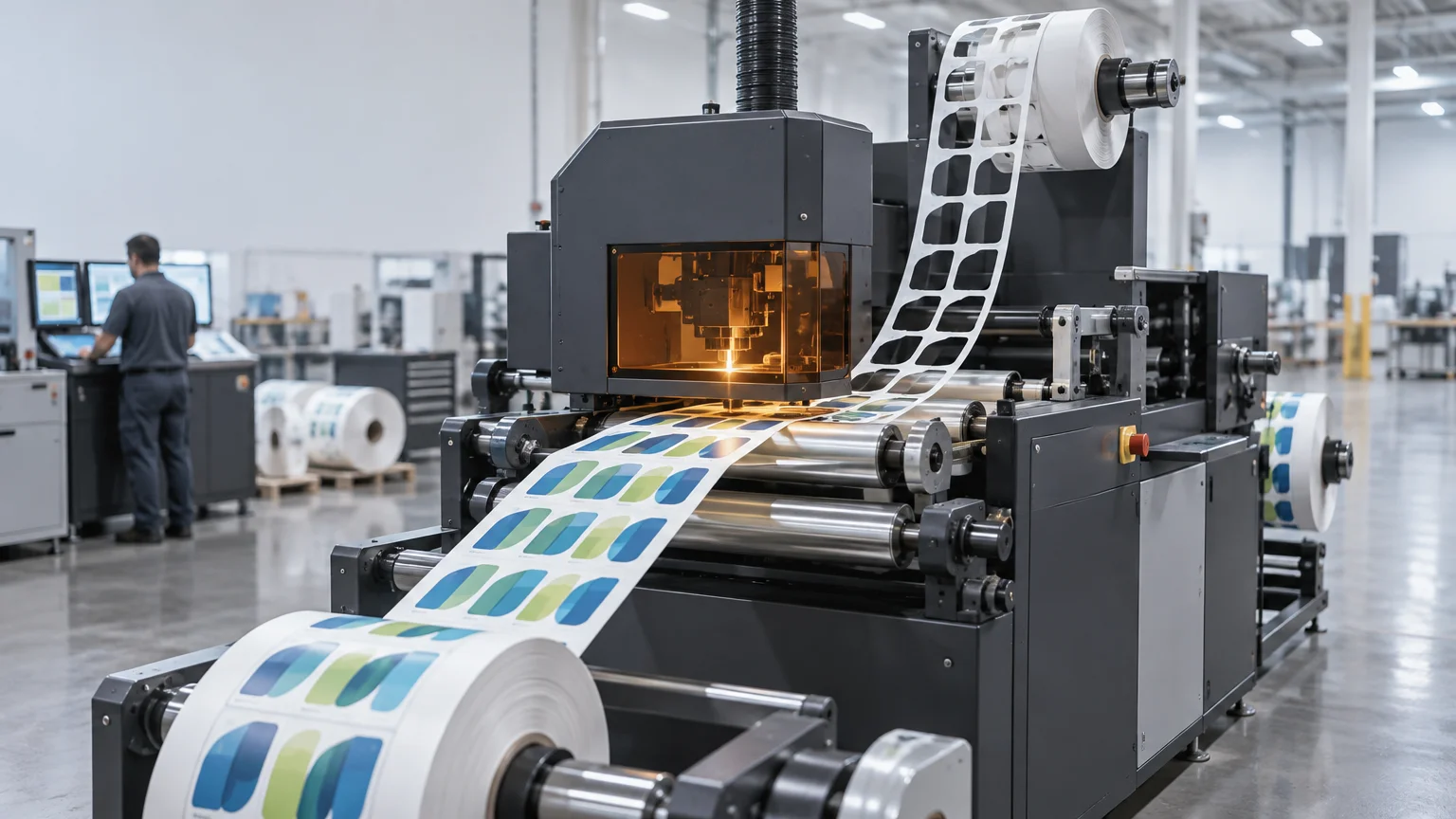
A laser system receives a digital cut file and steers the beam around the required contour. ABG’s published DigiLase specification, for example, lists PDF and SVG cut-file compatibility as well as single- and dual-head CO₂ configurations. Those details are model-specific, but they illustrate the fundamental workflow change: the contour is software-defined rather than fixed in a physical die.
That distinction matters when a shop is producing many short orders, testing new products, or accepting unusually shaped work. It can be particularly useful in an ecommerce environment serving custom sticker orders, where designs, quantities, and contours may change from one order to the next. A revised cut line can become a file change instead of a tooling purchase, provided the material and revised geometry have already been qualified.
The removed work is real. ABG describes avoiding traditional dies, along with associated setup, handling, storage, and waste, as benefits of its digital finishing workflow. Those are manufacturer-stated benefits rather than guaranteed savings, but they identify the cost buckets a converter should measure. A reported installation at Enterprise Print Group similarly described finishing preparation in its press-to-laser workflow as virtually nonexistent because dies were not needed. That is one operator’s experience, not an industry benchmark. Read the Enterprise Print Group installation report
What changes—and what does not
| Production issue | Laser finishing | Conventional die-cutting |
|---|---|---|
| New contour | Load and verify a digital cut path; no shape-specific cutting die | Obtain, mount, and set the appropriate tool |
| Late design revision | Potentially a file-level change, followed by validation | May require modifying or replacing the die |
| Best-fitting job mix | Short runs, many SKUs, prototypes, variable shapes, volatile demand | Repeat work, longer runs, stable constructions, throughput-sensitive jobs |
| Running performance | Depends heavily on contour length, material, laser configuration, labels across, and stripping | Can deliver high sustained output once a proven tool and construction are set |
| Matrix risk | Still present; intricate cuts can make the waste skeleton harder to remove | Still present, but familiar tooling and layouts may offer a proven production window |
| Consumable or tooling cost | No shape-specific die, but includes extraction filters, energy, optics maintenance, service, and capital recovery | Die purchase, repair, sharpening, storage, mounting labor, and capital recovery |
| Validation | Cut edge, liner protection, adhesive behavior, matrix stripping, dispensing, and application | Kiss-cut depth, tool pressure, liner damage, stripping, dispensing, and application |
| Facility requirements | Enclosure, fume extraction, utilities, cooling where specified, web handling, and service access | Tool handling and storage, web handling, guarding, setup space, and service access |
Short-run economics begin with total job cost
The weak way to compare laser and die finishing is to ask which machine is faster. The useful question is which route produces the required quantity of acceptable labels at the lower total cost while meeting the deadline.
For a die-cut job, include the tool price, procurement administration, incoming inspection, mounting and setup labor, setup stock, press or finishing time, stripping losses, tool storage, maintenance, and the cost of waiting for the die. If a repeat order will reuse the tool, decide how many expected runs should share that tooling cost rather than assigning it all to the first order.
For laser production, include file preparation, cut-path testing, setup stock, actual running time, extraction filters, energy, optics and maintenance allowances, stripping losses, and the machine’s hourly capital burden. A laser may avoid a die charge but consume more machine time on a dense or intricate contour. Tool-less does not mean costless.
A practical quoting formula is: total job cost equals preproduction plus setup plus tooling or laser consumables plus running time multiplied by the burdened hourly rate, plus expected waste and outside costs. Run the formula both ways. Then test how the answer changes if the quantity doubles, a repeat order arrives, or the customer revises the shape.
There is no universal crossover quantity. A simple oval on a narrow web and an intricate contour with long beam travel are different laser jobs even at the same label count. Likewise, an inexpensive flexible die reused every month has different economics from a one-time tool ordered for an uncertain product launch.
Matrix stripping remains the reality check
A laser can cut a contour that looks perfect under inspection and still create an unstable converting job. The waste skeleton must survive the path from cutting station to stripping point, separate cleanly, and wind without breaking or pulling labels from the liner.
Narrow waste sections, large gaps, counter-rotating outlines, thin materials, aggressive adhesives, and differences between paper and film can all make stripping harder. Spilker identifies these as recurring matrix-handling challenges. This is why the most visually impressive cut shape is not always the most production-friendly shape.
Material suppliers make the same point from another direction. 3M’s guidance for destructible durable label materials recommends preproduction trials and notes that matrix width, edge trim, and the stripping method may need special treatment. A fragile face stock or unusual adhesive construction can narrow the operating window regardless of how the cut was generated.
Before quoting, test the actual face stock, adhesive, liner, laminate, ink coverage, and varnish. Run enough material to reach normal web speed and tension rather than approving a few hand-fed samples. Observe matrix breaks, label lift, liner damage, adhesive stringing, residue, edge discoloration, and roll quality. If the labels will be automatically dispensed, test them on representative application equipment as well.
Why headline speed is a poor buying metric
Laser throughput is job-dependent because the beam must travel around the required geometry. Total contour length, number of labels across the web, cut complexity, required energy, material response, laser power, number of heads, and registration behavior can all affect output. The downstream stripping and rewinding sections must also remain stable at the selected speed.
Published maximums need careful reading. Older ABG literature listed 100 m/min for one Digilase Series 3 model, while a current Spilker S-CON Starline configuration lists a mechanical maximum of 180 m/min. Neither number establishes real output on the same label job, and they should not be treated as a direct laser-versus-rotary comparison.
The number that belongs in a capital proposal is good rolls per staffed hour on the shop’s representative work—not the highest web speed shown on a specification sheet. A slower nominal process can still win if it removes hours of tooling delay and changeover. A fast machine can still lose if the matrix repeatedly breaks or operators must reduce speed to protect the liner.
Where conventional dies still win
Rotary and semi-rotary dies remain strong when demand is stable, the material-tool combination is proven, and the run is long enough to spread tooling and setup costs across a large quantity. Rotary die-cutting is valued for high processing speeds and dimensional accuracy, while cutting tools can be tailored to the material, contour, and required depth. Some tools can also be repaired or re-sharpened.
That makes conventional tooling difficult to displace on repeat jobs with predictable schedules and high sustained volumes. The converter already knows the setup, stripping behavior, waste rate, and attainable speed. A stored die may also make reorders straightforward, assuming tool identification and storage are under control.
Semi-rotary equipment can further change the calculation because it offers a way to use physical tooling without requiring a full rotary repeat match for every job. The right comparison is therefore not simply laser versus old-fashioned finishing. It may be laser versus a highly automated semi-rotary line with fast setup, established tooling, inspection, and reliable matrix handling.
Installation is more than adding a cutting station
Laser finishing needs an enclosed, properly specified production system. ABG’s DigiLase literature describes Class 1 equipment and includes a Purex Filter 5000i fume-extraction system, illustrating that containment and extraction are integral rather than optional accessories. Exact requirements vary by model, material, facility, and local rules.
A purchasing review should cover the complete line: unwind capacity, web cleaning, tension control, registration, laser enclosure, extraction, cooling and electrical requirements, inspection, matrix rewind, slitting, finished-roll rewind, networking, fire and safety provisions, service access, and operator training. The buyer should also ask how filter condition affects production and what happens when extraction, registration, or web tension falls outside limits.
Do not accept a generic sample as proof. Supply representative printed rolls, including difficult constructions and actual artwork. Ask the vendor to document setup time, sustained speed, waste, interventions, edge appearance, liner condition, stripping stability, and finished-roll quality. Keep those samples and run dispensing or application tests before signing off.
A practical decision checklist
- Measure how many new dies the shop buys, how long they take to arrive, and how much labor goes into mounting, locating, storing, and maintaining them.
- Segment the job history by run length, number of SKUs, repeat frequency, shape changes, material construction, and finishing deadline.
- Select representative easy, typical, and difficult jobs for vendor trials; do not build the business case around one favorable demonstration file.
- Calculate total job cost for both laser and die routes using the shop’s actual labor rates, waste, machine burden, and expected repeat frequency.
- Validate matrix stripping at sustained speed, not just the quality of stationary or low-speed cut samples.
- Test cut edges, liner integrity, adhesive response, rewinding, dispensing, and final application on the actual construction.
- Confirm extraction, utilities, floor space, workflow integration, service response, consumables, maintenance, and operator-training requirements.
- Base the investment case on good rolls per staffed hour and avoided changeover cost, not advertised maximum speed alone.
The buying conclusion
Laser finishing deserves serious attention when a converter’s margin is being eroded by frequent die purchases, short runs, changing contours, small repeat probability, or long tooling lead times. Its most defensible value is responsiveness: the cutting geometry becomes part of the digital job rather than an object that must be purchased and managed.
But the laser does not repeal converting physics. Material response, matrix integrity, tension, inspection, rewinding, and application performance still decide whether output is commercially usable. Converters should choose laser finishing for a measured job mix, not for the abstract appeal of tool-less production. Take a representative month of work, cost both routes, and insist on production-length trials. That exercise will reveal whether laser finishing removes a genuine bottleneck or merely moves it farther down the web.
References
- DIGILASE &
DIGILASE DUO
SPECIFICATION
Contact us: - digicon
Digital Finishing Machines
Digicon Series - Enterprise Print Group adds Screen Truepress Jet L350UV SAI E – Label and Narrow Web
- The Labelshifter Plus – An effective aid for the fast and steady strippingof waste matrixes.
- ASK A 3M EXPERT
- www.spilker.com
- Function rotary die cutting
- Rotary cutting tools for printing, label, automotive, pharmaceutical and packaging