
TLDR
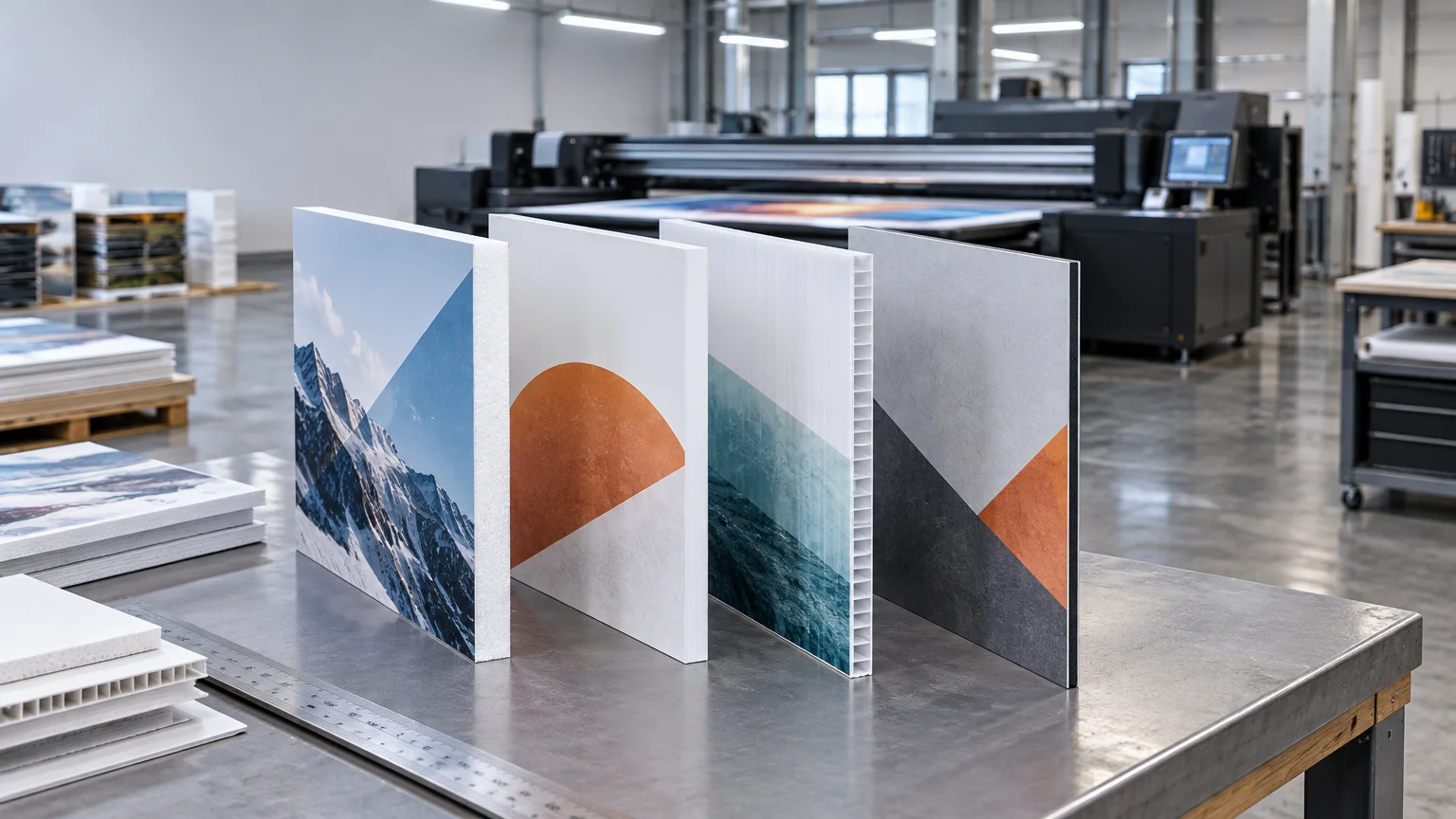
The useful answer to a rigid print substrates comparison is conditional. Choose foam board for protected, short-term indoor displays; foam PVC for more durable indoor graphics and fabricated displays; corrugated plastic for lightweight temporary signs; and aluminum composite material, or ACM, when stiffness, dimensional stability, and installation quality justify more material and handling expense. Printable acrylic belongs in the conversation when clarity, translucency, polished edges, or second-surface presentation matters. Do not select any of them on sheet price alone.
Rigid board printing succeeds when the material matches the environment, printer, finishing path, shipping method, and mounting system. The cheapest sheet can become the expensive choice after poor adhesion, flute marks, warpage, damaged corners, difficult routing, or an on-site remake. Material selection is one part of the wider commercial printing ecosystem, but it is the decision most likely to determine whether a board survives production and installation.
Rigid print substrates comparison at a glance
| Material | Best fit | Production strengths | Main risk | Finishing and installation |
|---|---|---|---|---|
| Paper-faced foam board | Short-term indoor presentations, event graphics, countertop signs and mounted posters | Lightweight, easy to cut and practical for protected displays | Edges dent easily; moisture, rough handling and unsupported spans can expose its limitations | Simple knife cutting and light mounting; protect corners during packing |
| Foam PVC | Indoor signs, retail displays, dimensional graphics and fabricated display components | Solid printable face, broader fabrication options and a more finished appearance than fluted board | The exact grade, thickness and ink combination still need testing; large sheets can become awkward to ship | Can be cut, routed, drilled and assembled, subject to grade and thickness |
| Corrugated polypropylene | Campaign signs, temporary directional graphics, event work and other high-volume lightweight applications | Low weight, printable faces and efficient handling for temporary programs | Flutes can affect appearance and cutting; thin material may be unsuitable for a given UV workflow | Can be knife-cut, die-cut or converted with flute direction and mounting method in mind |
| ACM | Longer-term signs, mounted panels, architectural graphics and work requiring a stiff, flat presentation | High stiffness relative to panel thickness, strong fabrication potential and interior or exterior application options | Higher handling, fabrication and freight consequences; not every ACM face is equally optimized for direct printing | Commonly routed, drilled and mechanically mounted; edge and corner protection matter |
| Printable acrylic | Premium displays, clear or translucent graphics, illuminated work and polished-edge components | Distinct visual depth and options for printing through or behind a clear face | Static, sheet bow, head clearance and surface compatibility can make production unforgiving | Requires controlled handling and suitable cutting, routing or polishing processes |
This table is a selection shortcut, not a durability warranty. A weather-resistant board does not automatically make a weather-resistant finished sign. Ink chemistry, curing, edge exposure, mounting hardware, wind load, cleaning, climate, and installation quality all affect service life.
Foam board is for protected, short-duration work
Conventional foam board earns its place through simplicity. It is appropriate when a graphic will sit on an easel, counter, wall, or display stand in a controlled indoor environment. It is less convincing when the board will be repeatedly transported, exposed to moisture, handled by the public, or expected to bridge a wide unsupported span.
The operational trap is treating low sheet cost as low job cost. A presentation board that leaves production cleanly can still arrive with crushed corners or a dented face. Packaging labor and remake exposure therefore belong in the estimate. If the customer expects a rigid sign rather than a disposable presentation panel, foam PVC may be the safer upgrade.
Foam PVC is the practical indoor display default
Foam PVC sits in a useful middle ground. It looks and handles more like a fabricated sign material than paper-faced foam board, but it does not impose all the routing, edge, and mounting considerations associated with ACM or acrylic. Palram positions PALIGHT foam PVC for printing, signage, display, lamination, and fabrication, including quick-turn and higher-volume print applications.
That does not make every PVC sheet interchangeable. Surface formulation, density, thickness, storage history, ink set, cure settings, and image coverage can change the result. A shop should qualify the exact grade it plans to buy, especially before accepting a job with heavy ink coverage, tight color requirements, routed details, or outdoor exposure.
Foam PVC is often the sensible choice for retail point-of-purchase panels, menu boards, informational signs, and display components that need cleaner edges and more handling resistance than basic foam board. Its weakness is not a single technical defect; it is the temptation to sell it as a universal sign board without examining span, heat exposure, attachment method, or transport.
Corrugated plastic wins on weight and temporary utility
Corrugated plastic, often called fluted polypropylene, is built differently from a solid sheet. Coroplast Print uses printable outer faces around a fluted core, and the manufacturer states that its print sheets are corona-treated on both sides for inks and adhesives. Coroplast Print product information
That construction makes it useful for temporary campaigns, directional signs, event programs, yard signs, and high-volume jobs where low weight simplifies handling and distribution. It also creates its limitations. Flute direction can influence bending, cutting, mounting, and the visibility of surface irregularities. Small text, smooth gradients, and premium retail imagery may reveal the material character more readily than bold campaign graphics.
Thickness is a production variable, not merely a purchasing specification. Coroplast specifically advises against UV printing on Coroplast Print thinner than 4 mm. A shop running a UV flatbed should therefore check the precise board thickness, surface treatment, vacuum hold-down, head clearance, and ink adhesion rather than assuming every fluted sheet will run like familiar 4 mm stock.
ACM is worth it when stiffness and presentation matter
ACM consists of aluminum skins bonded to a core. Standard DIBOND, for example, is described as having two 0.3 mm aluminum cover sheets around a polyethylene core, with uses including digital printing, screen printing, routing, lamination, and interior or exterior applications. The DIBOND product guide provides the manufacturer’s construction and application details.
The important qualification is that ACM is a category, not one uniform print surface. 3A Composites sells DIBOND digital as a distinct product with a coating system designed for direct digital printing. That alone is a warning against assuming an unverified general-purpose ACM panel will behave identically on press.
ACM becomes attractive when a customer values a flat, stiff panel; when a sign must be drilled or mechanically mounted; or when a thin-looking panel needs more structural authority than foam PVC or corrugated plastic provides. The tradeoffs are equally practical: panels can require more deliberate cutting and routing, exposed edges may affect presentation, and damaged corners are expensive. Freight, protective packaging, hardware, fabrication time, and installation labor can outweigh the difference in raw sheet price.
Printable acrylic is a specialty option, not a premium substitute for everything
Acrylic enters the discussion when transparency or translucency is part of the design. It can support clear displays, illuminated graphics, layered visual effects, and reverse or second-surface workflows in which the image is viewed through the sheet. Those effects justify acrylic; prestige language by itself does not.
As with ACM, shops should distinguish a material family from a print-qualified grade. ACRYLITE digital print is formulated for enhanced adhesion with UV-curable inks, which does not establish that standard acrylic will deliver the same direct-print performance. Manufacturer guidance also calls for moisture control and horizontal storage to reduce warpage. A bowed sheet can create inconsistent printing and a printhead-strike risk.
Static control, protective masking, surface cleanliness, sheet flatness, vacuum hold-down, head clearance, white-ink sequencing, cutting, and edge finishing all require attention. Acrylic should be quoted as a production system, not merely as a more expensive transparent board.
What actually changes production cost
Material invoices show only part of the economics. The more useful calculation is completed-job cost divided by accepted, installable pieces. That exposes the operational differences between substrates.
- Adhesion: Test the actual sheet grade and surface, not a generic sample carrying the same material-family name.
- Flatness and hold-down: A light, bowed, or warped sheet can compromise registration, head clearance, and unattended printing.
- Finishing: Knife cutting, sawing, routing, drilling, polishing, and die-cutting require different labor, tooling, extraction, and operator skill.
- Packing and freight: Lightweight does not mean damage-proof. Corner protection, interleaving, pallet dimensions, and shipment orientation can decide whether a job arrives intact.
- Installation: Stakes, adhesive systems, standoffs, frames, screws, and mechanical fasteners impose different loads on the board.
- Remake exposure: A consequential installed panel deserves more testing than a disposable counter sign, even if both fit on the same flatbed.
A simple worked decision
Consider a run of temporary directional signs for a weekend event. Corrugated plastic may minimize weight and simplify distribution, while its flute texture is unlikely to undermine large arrows and short messages. Using ACM would add stiffness but could also add unnecessary fabrication, packing, and handling cost.
Change the assignment to a permanently mounted identification panel at a customer entrance and the calculation reverses. Flatness, edge quality, mounting integrity, and presentation become more important than carrying weight. ACM may then be the lower-risk choice even with a higher initial material and fabrication cost. The specification follows the failure mode, not the sales description.
Pre-quote checklist for rigid board jobs
- Define whether the job is indoor, outdoor, protected, illuminated, transported, or repeatedly handled.
- Establish the expected campaign duration without turning it into an unsupported lifespan guarantee.
- Confirm how the panel will be mounted and whether it must resist bending, impact, heat, moisture, or wind.
- Check the printer’s maximum thickness, head-clearance procedure, vacuum performance, and approved media guidance.
- Specify the exact manufacturer, product grade, color, thickness, surface, and lot where consistency matters.
- Map the finishing path: knife, saw, router, drill, die, polish, bend, laminate, or mechanical assembly.
- Identify which face will be visible and whether marks, flutes, exposed edges, or fasteners are acceptable.
- Price packaging, freight, installation, and realistic remake exposure alongside ink and sheet consumption.
- Test the exact substrate, ink, coverage, cure settings, finishing method, and cleaning process before committing to consequential production.
The best board is the one with the cheapest acceptable failure risk
Use foam board for protected, short-lived presentation graphics. Move to foam PVC when an indoor display needs a more durable face and broader fabrication options. Choose corrugated plastic when temporary utility, low weight, and campaign volume matter more than premium surface appearance. Specify ACM when stiffness, mounting, flatness, and installed presentation justify the extra handling. Reserve printable acrylic for designs that genuinely benefit from clarity, translucency, depth, or polished fabrication.
Before selling an unfamiliar rigid-media job, obtain a production sheet from the intended supplier and run the complete process—not just a small adhesion swatch. Print representative coverage, cure it, cut or route it, pack it, and test the proposed mounting method. The right substrate is not the one that looks best on a sample rack. It is the one that reaches the installation intact, performs as specified, and leaves enough margin to make the job worth producing.